
30 to 60 minutes
Minimal; swelling and bruising typically settle within 3 to 7 days
Visible immediately, refining over 1 to 2 weeks as the filler settles
Usually one, with a touch-up at two weeks if needed
Maintenance every 12 to 15 months depending on formulation and area
Faces are not still. They talk, laugh, and register emotion hundreds of times a day, and a filler that looks correct at rest can read as stiff the moment the face starts moving. That gap between how a result photographs and how it behaves in conversation is what the RHA collection was built to close.
RHA® Fillers smooth wrinkles and restore volume while stretching and recovering with the surrounding tissue. That makes them particularly well suited to the most expressive parts of the face, where fine lines and volume loss show up first and where a rigid product is most obvious.
RHA® Fillers are a collection of resilient hyaluronic acid dermal fillers developed specifically for dynamic facial wrinkles and folds. Hyaluronic acid occurs naturally in the body, where it binds water and provides hydration and structural support to the skin. Injecting it replaces what age and volume loss have taken away.
What sets the RHA collection apart is the manufacturing process, not the ingredient. Traditional hyaluronic acid fillers require heavy chemical modification to hold their shape, which makes the resulting gel stiffer and less able to move. RHA uses a gentler process that preserves longer, more natural hyaluronic acid chains, producing a filler that stretches under movement and recovers afterward.
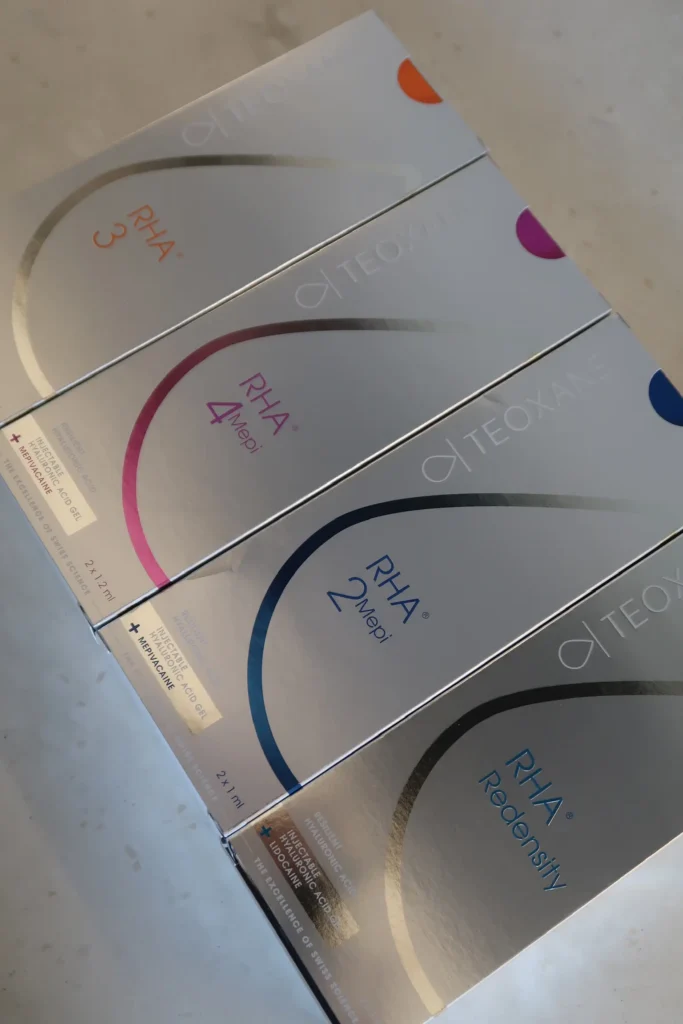
The collection includes four formulations of increasing thickness, each intended for a different injection depth and degree of correction. Matching the formulation to the area largely determines whether a result looks natural, which is why the full range is kept on hand rather than a single product used everywhere.
The lightest formulation in the collection, designed for the most delicate work. Redensity is placed superficially to smooth fine lines around the lips and soften early perioral etching, and it is often used for lip hydration where added volume is not the goal. Its softness lets it sit that close to the surface without becoming visible.
A light to moderate formulation for fine and moderate dynamic wrinkles. RHA® 2 is commonly used for lip enhancement, perioral lines, and superficial nasolabial folds where subtle correction is wanted. It provides more support than Redensity while still remaining soft enough for mobile areas.
A mid-weight formulation for moderate to severe dynamic wrinkles and folds. RHA® 3 handles deeper nasolabial folds, marionette lines, and fuller lip augmentation where structure matters as much as volume. It is placed slightly deeper in the tissue than the lighter formulations.
The most robust formulation, intended for deep injection and structural volume restoration. RHA® 4 is used in the cheeks, midface, temples, and along the jawline where meaningful lift and contour are needed. Despite being the thickest in the collection, it retains the flexibility that defines the range.
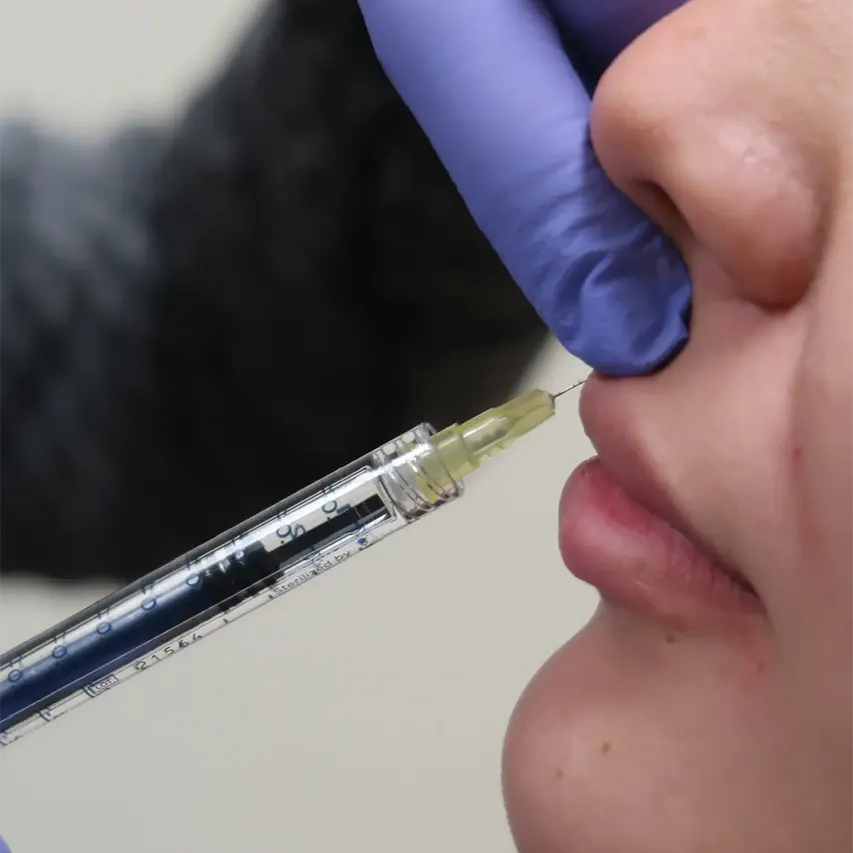
RHA® Fillers restore lost volume and soften wrinkles by placing resilient hyaluronic acid gel precisely beneath the skin. Once injected, the gel draws in water, plumping the treated area and supporting the tissue above it. Results are visible immediately, then continue to refine over the following days as the product integrates.
The flexibility comes from how the hyaluronic acid is processed. Preserving longer chains means the gel behaves less like a fixed implant and more like the tissue surrounding it, stretching when you smile and returning to shape afterward. In an area such as the perioral region, which moves constantly, that difference is the difference between a result that reads as natural and one that does not.
Placement depth matches the formulation and the concern. Lighter products sit closer to the surface for fine lines, while heavier ones are placed deeper against bone or in the fat pads for structural support. This is why a full facial assessment precedes treatment rather than simply agreeing on a syringe count.
Patients generally arrive with a specific concern rather than a general interest in filler, and what they want is correction that no one else can identify as correction. The RHA collection is built around that outcome rather than maximum volume.
Engineered for dynamic areas, the product stretches and recovers with your expressions instead of holding a fixed shape.
The flexible formulation preserves softness and fluidity, so results look seamless whether your face is at rest or in motion.
Depending on formulation and treatment area, results can last up to 15 months, meaning fewer maintenance visits.
Volume restoration and wrinkle smoothing are visible as soon as treatment is complete, with continued refinement as the filler settles.
Four distinct formulations allow correction tailored precisely to wrinkle depth, facial structure, and aesthetic goals.
Treatment is performed in office, and most patients return to normal activities the same day.
Because the collection spans four formulations, RHA can be placed almost anywhere on the face where volume or line correction is needed. The formulation changes by area, which allows the same product family to treat both fine perioral lines and deep midface volume loss.
Adds volume, definition, and hydration while preserving natural movement.
Softens fine vertical lines in one of the most mobile parts of the face.
Fills and softens the lines running from the nose to the corners of the mouth.
Lifts the downward lines extending from the mouth toward the chin.
Restores fullness and re-establishes the face’s natural high point.
Rebuilds structural support where age-related descent begins.
Fills hollowing that makes the upper face read as gaunt or tired.
Softens shadowing beneath the eyes using the lightest formulations.
Improves projection and balance in profile.
Sharpens definition and restores contour along the lower face.
Fills the depression that forms in front of developing jowls.
Smooths bumps and refines contour without surgery.
Addresses volume loss and contour irregularities across the upper face.
Softens deeper vertical lines that persist between the brows.
Restores lost volume where thinning skin exposes tendons and veins.
Most patients present with several of these at once, since volume loss and line formation tend to progress together. A treatment plan usually addresses the underlying structural change first, because correcting support often improves the lines above it without treating them directly.
Good candidates are adults in reasonable health who want to soften dynamic wrinkles or restore volume, particularly in expressive areas where a stiffer filler would be noticeable. RHA suits patients who have been unhappy with previous filler results that looked correct in photographs but felt heavy or unnatural in movement.
It also suits patients approaching filler for the first time who want something reversible. Hyaluronic acid fillers can be dissolved with an enzyme if a result is not what you wanted, which is a meaningful difference from collagen stimulators or fat-based products where correction is far harder.
Treatment is not appropriate if you are pregnant or nursing, have an active infection or inflammatory skin condition in the treatment area, or have a known allergy to hyaluronic acid or lidocaine. A history of severe allergic reactions, certain autoimmune conditions, or blood-thinning medication warrants a longer conversation at your consultation before proceeding.
Treatment begins with a facial assessment, not a needle. The provider evaluates structure, symmetry, and how your face moves, because the plan depends on movement as much as volume. At this point, we decide which formulations to use and where to place them.
The area is cleansed, and a topical numbing cream is applied for roughly twenty minutes. Most RHA products also contain lidocaine, so comfort improves further as injection begins. Placement takes fifteen to forty-five minutes depending on how many areas are being treated, and you will feel pressure and brief stinging rather than sustained pain.
You will see the correction immediately, though some of what you see that day is swelling rather than the final result. Mild swelling, tenderness, and occasional bruising are normal and typically settle within a few days. We usually schedule a follow-up at two weeks to assess the settled result and add a small touch-up if needed.

Most of what improves a filler outcome happens before the appointment, and nearly all of it relates to bruising. The following applies in the week before your treatment at our Penn Avenue office in Pittsburgh.
The first forty-eight hours determine how well the filler settles and how quickly swelling resolves. These instructions apply from the moment you leave our Pittsburgh office. Contact us if you notice severe pain, blanching or whitening of the skin, or any vision change, as these need immediate attention.
Longevity depends on which formulation was used and where it was placed. Lighter products in delicate areas generally last about a year, while heavier formulations used for structural support in the cheeks and jawline can last up to fifteen months.
Movement is the other factor. Filler placed in constantly mobile areas such as the lips metabolizes faster than filler placed in the midface, which is why lips typically need refreshing sooner. Most patients settle into an annual maintenance rhythm, and you can see the range of results in our before-and-after gallery.
Fillers address volume and static lines, but they do not stop the muscle activity that creates dynamic wrinkles in the first place. Pairing addresses both halves of the problem, which is why combination treatment is more common than the exception.
Several injectable options are available at the practice, and they differ in what they are made of and how long they last. This comparison clarifies those differences rather than ranking them, since many treatment plans use more than one.
Treatment | Primary Purpose | Longevity | Best For |
|---|---|---|---|
RHA® Fillers | Flexible hyaluronic acid volume for dynamic areas | Up to 15 months | Expressive areas, perioral lines, lips, midface |
Juvederm | Hyaluronic acid volume replacement | 9–18 months | Lips, cheeks, moderate folds |
Restylane | Hyaluronic acid filler | 6–18 months | Natural-looking contour and line correction |
Radiesse | Immediate volume plus collagen stimulation | 12–18 months | Deep folds, jawline contour, skin tightening |
Sculptra | Gradual collagen stimulation | Up to 2+ years | Progressive volume restoration |
Filler results depend far more on who holds the syringe than on what’s in it. Aesthetic Skin & Laser Center approaches RHA as a matter of facial assessment and product selection, not a transaction measured in syringes.
Physician-Delivered Injectable Artistry: Dr. Roxana Barad, MD, FAACS performs treatment personally. She is a board-certified physician and oculoplastic surgeon with more than twenty years in practice, trained at Albany Medical College with an ophthalmology residency at Wills Eye Hospital and fellowship training at Harvard Medical School. Manufacturers have also selected her to train other physicians in injectable techniques.
Assessment Before Injection: Every treatment begins with an evaluation of structure, symmetry, and how your face actually moves, since movement determines formulation as much as anatomy does.
Full RHA® Collection Available: Redensity, RHA® 2, RHA® 3, and RHA® 4 are all kept in-house, so we choose the product to suit the area rather than treating with whatever is stocked.
Expression-Preserving Results: The goal is correction nobody can identify as correction, which means resisting the pressure to overfill and knowing when to stop.
Comprehensive Injectable Options: With neuromodulators, collagen stimulators, and regenerative injectables all available, the recommendation reflects what your face needs rather than what the practice happens to offer.
Patients travel to our Penn Avenue location from across the Pittsburgh region and the surrounding communities. The practice sits in the Garfield and Bloomfield corridor, within easy reach of the East End and a straightforward drive from the South Hills and Sewickley.
General anesthesia is never used for filler treatment. A topical numbing cream is applied for about twenty minutes beforehand, and most RHA formulations also contain lidocaine, which takes effect as injection begins. Patients typically describe pressure and brief stinging rather than pain, and the lips are the most sensitive area for most people.
Cost depends on which formulations your plan uses and how many syringes are needed, since a single syringe of Redensity for lip lines prices very differently from a full midface restoration. We quote pricing at consultation once the plan is defined, rather than as a flat rate that wouldn’t reflect your anatomy. Financing is available through Cherry on our patient financing page, with plan lengths from three to twenty-four months, 0% APR options for eligible patients, and no hard credit check to apply.
RHA fillers are FDA-approved and made from hyaluronic acid, a substance the body already produces, which helps explain their well-established safety profile. The most common effects are temporary swelling, tenderness, and bruising at the injection sites. Rare but serious complications, such as vascular occlusion, are why physician training and anatomical knowledge matter, and why treatment happens in a clinical setting.
The immediate result is visible as soon as treatment finishes, though some of what you see on the day is swelling rather than correction. The settled result emerges over one to two weeks as swelling resolves and the filler integrates with the surrounding tissue. From there, the result is stable until the product gradually metabolizes over the following year or more.
Common side effects include swelling, redness, tenderness, and bruising at the injection sites, which usually resolve within three to seven days. Small lumps or firmness can occur as the filler settles and typically soften on their own. Contact us promptly if you experience severe or increasing pain, blanching or whitening of the skin, or any vision change, as these require immediate attention.
All three are hyaluronic acid fillers, but they differ in how the gel is manufactured. Traditional fillers require heavier chemical modification to hold their shape, which produces a stiffer product. RHA uses a gentler process that preserves longer hyaluronic acid chains, resulting in a filler that stretches and recovers with facial movement. That makes it particularly suited to expressive areas, while the other products remain excellent choices where movement is less of a factor.
Results last up to fifteen months depending on which formulation was used and where it was placed. Heavier formulations used for structural support in the cheeks and jawline tend to last longest, while lighter products in the lips metabolize faster because the area moves constantly. Most patients return for maintenance around the one-year mark.
There is no true downtime, and most patients return to normal activities the same day. Plan for visible swelling and possible bruising for three to seven days, which is why treatment is best booked at least two weeks before any significant event. Avoid strenuous exercise and heat for the first forty-eight hours.
Lip enhancement commonly uses one syringe, while restoring midface volume often requires two or more depending on how much has been lost. The honest answer is that syringe count depends on your anatomy rather than a package, and a plan built around a natural result may require more than one appointment. Your consultation gives you a specific number and a cost before anything is scheduled.
Yes, and this is one of the practical advantages of hyaluronic acid fillers generally. An enzyme called hyaluronidase breaks down the filler and can be injected to reduce or remove a result you are unhappy with, usually within a day or two. This reversibility is a meaningful difference from collagen stimulators and fat-based fillers, where correcting an unwanted result is considerably more difficult.
Before treatment, avoid blood-thinning supplements such as fish oil and vitamin E for a week if your physician agrees, and skip alcohol for twenty-four hours, since all of these increase bruising. Afterward, avoid touching or massaging the area, strenuous exercise, saunas, and extended heat for forty-eight hours. Full instructions are in the pre-treatment and post-treatment sections above, and you will also receive them in writing.
Combining them is extremely common and often produces a better result than either alone. Botox relaxes the muscles responsible for dynamic wrinkles, while filler restores lost volume underneath. They can be performed in the same appointment, though the sequence and placement are planned carefully so the neuromodulator does not migrate into recently injected filler.
Good candidates are adults in reasonable health looking to soften dynamic wrinkles or restore lost volume, particularly in expressive areas where a stiffer product would look unnatural. RHA suits patients who have been dissatisfied with previous filler that felt heavy in movement, and first-time patients who want a reversible option. We confirm candidacy at consultation, where we review your health history and any medications.
The best filler results are the ones nobody notices, including in conversation, mid-laugh, and across a dinner table. Getting there depends on choosing the right formulation for how your face actually moves, a judgment made in person rather than from a product brochure.
Dr. Roxana Barad, MD, FAACS, and the team at Aesthetic Skin & Laser Center see patients from across Pittsburgh and the surrounding communities. Call 412-683-3358 or reach us through our contact form to discuss what you hope to change. We are located at 4312 Penn Ave, Pittsburgh, PA 15224, a short drive from Shadyside, Squirrel Hill, and the Strip District.