30 to 60 minutes depending on areas and thread count
Minimal; swelling, tenderness, and bruising typically settle within 5 to 10 days
Immediate lift, with collagen-driven improvement building over 3 to 6 months
Usually one, repeated as the threads dissolve
Every 12 to 18 months for maintenance

There is a stage of facial aging where creams stop helping and surgery still feels like too much. Skin has begun to descend along the jawline and midface; filler alone would add weight without addressing the direction of travel, and a facelift is more intervention than the situation calls for.
PDO threads occupy that middle ground. They lift sagging skin mechanically at the time of treatment, then stimulate collagen production in the months that follow, so the result improves rather than fading. For patients dealing with early jowling or a softening jawline, it is often the most proportionate option available.
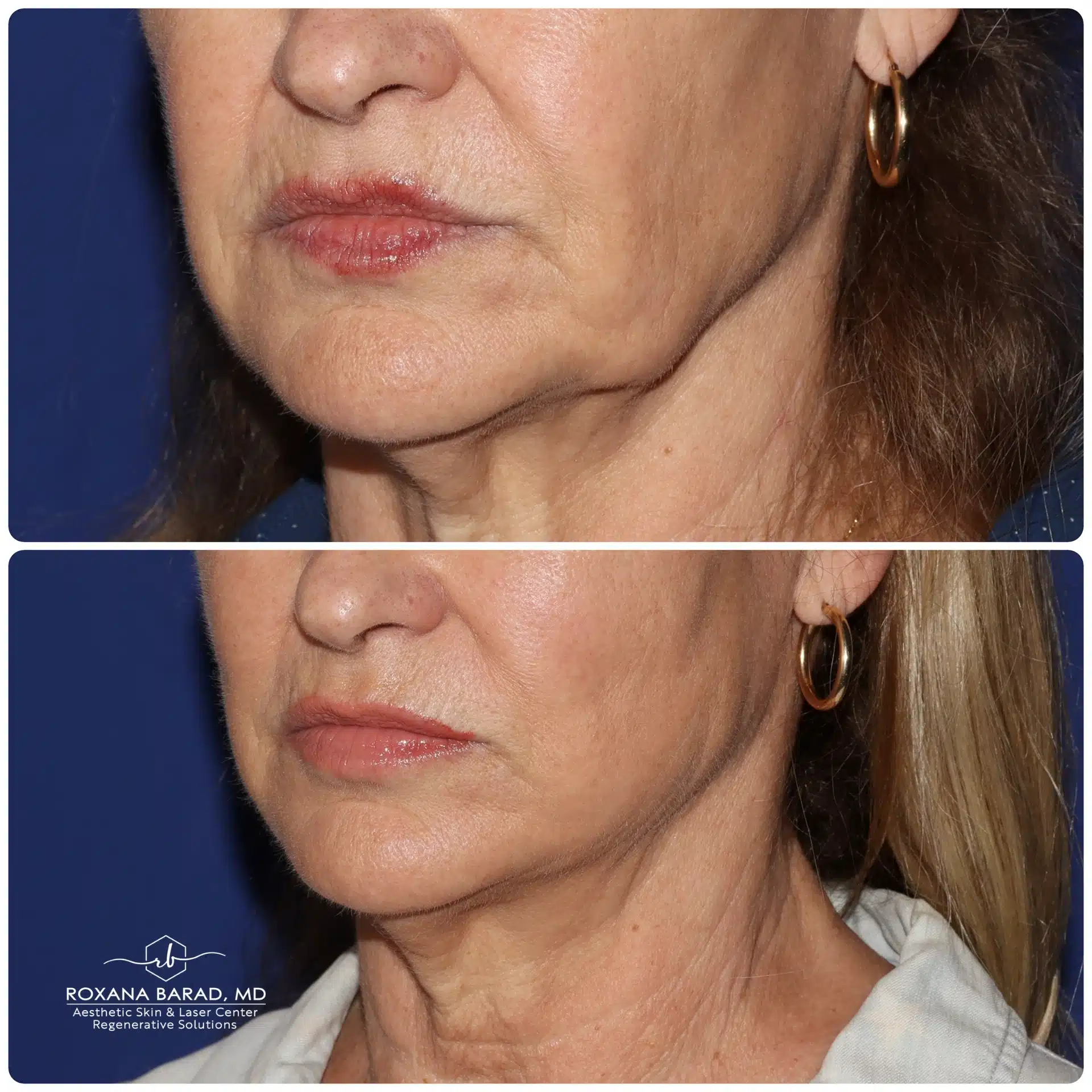
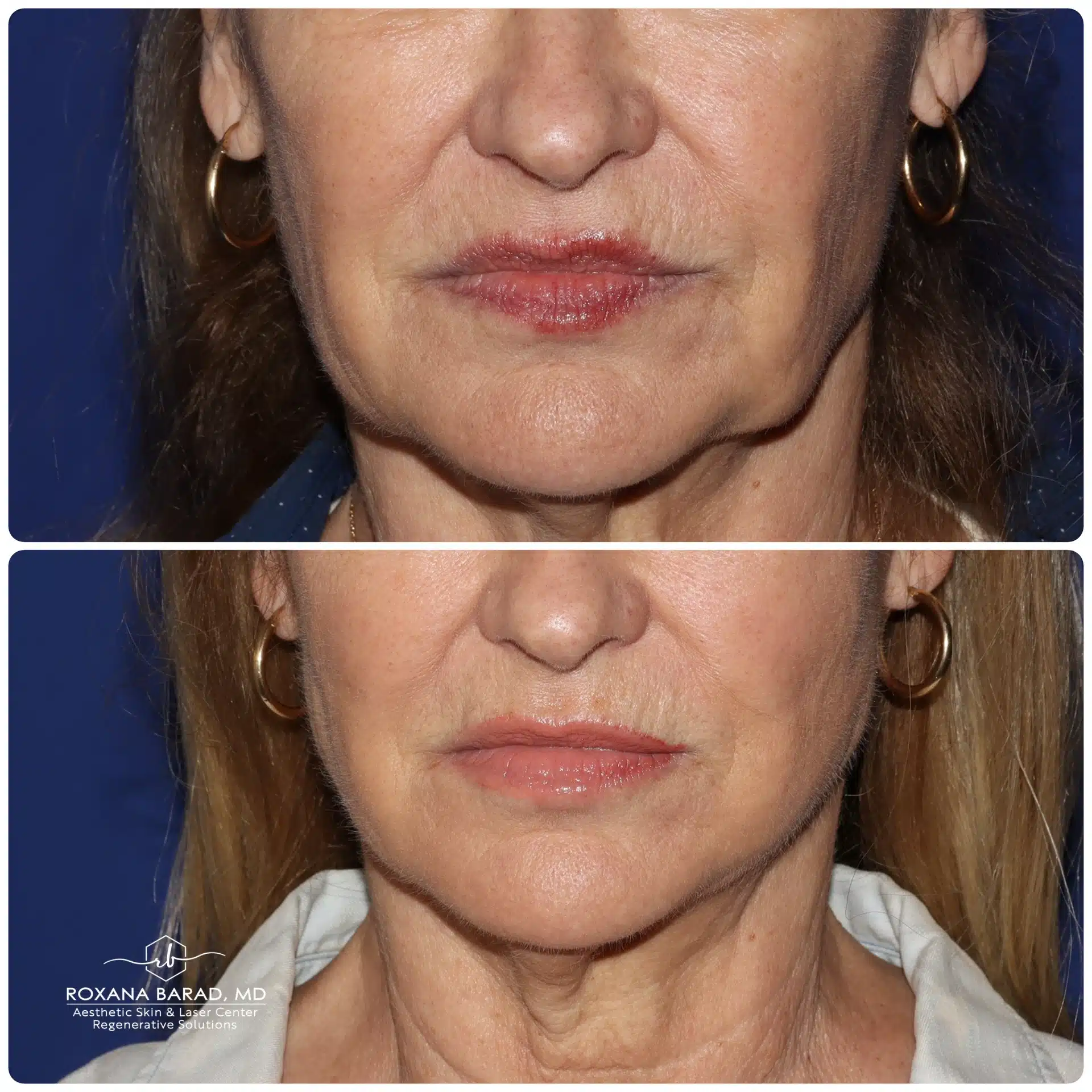
PDO threads are biodegradable sutures made from polydioxanone, a material used in surgical settings for decades and one that the body breaks down safely over time. When placed beneath the skin, they act as internal scaffolding, catching and holding tissue in a lifted position rather than adding volume to it.
The threads come in several forms, and the choice depends on the goal. Barbed threads have small directional projections along their length that grip tissue and produce the lift, while smooth threads have no barbs and are used to stimulate collagen across an area without repositioning it. Many treatment plans use both, with barbed threads providing lift and smooth threads improving the surrounding skin.
What makes them appealing is the second mechanism. As the polydioxanone dissolves over roughly six months, its breakdown triggers a controlled healing response that produces new collagen along the thread path. The scaffolding disappears, but the collagen it prompted remains, which is why results often look better at four months than at four weeks.

Treatment begins with mapping. The provider marks entry points and the intended path of each thread based on where the tissue has descended and the direction it needs to move, since a thread pulls along its length and the vector determines the result.
After placing local anesthetic, the provider introduces threads through a fine needle or cannula into the subcutaneous layer. Once positioned, the provider draws the tissue upward along the thread, and the barbs engage to hold it there. The lift is visible immediately, and the effect is mechanical rather than chemical.
Collagen stimulation begins straight away and continues for months. As the polydioxanone breaks down, fibroblasts along the thread path lay down new collagen, gradually replacing the mechanical support with the patient’s own tissue. The technique is highly customizable, which is why two patients receiving the same number of threads can end up with quite different results depending on placement.
The appeal of a thread lift is that it delivers two different things at once: an immediate change you can see leaving the office and a slower improvement that develops over months. Few non-surgical treatments do both.
Visible lifting appears right after the procedure, especially in areas with sagging or early volume loss.
The threads promote natural collagen renewal, improving skin strength and elasticity long after the lift.
No general anesthesia, no incisions, and no extended recovery, which is the main distinction from surgical lifting.
The change works with your existing features rather than altering them, avoiding an overdone or pulled appearance.
The thread type, count, and vector are adjusted to your anatomy, so the same treatment produces different results by design.
Although the threads dissolve, the collagen they stimulate continues improving the skin for 12 to 18 months.
Threads can be placed anywhere tissue has descended, and there is enough laxity to reposition. The face accounts for most treatment, though body areas where skin has loosened are increasingly common requests.
Lifts a heavy or descending brow to open the upper face.
Smooths and supports the upper face where laxity has developed.
Adds support where hollowing and descent narrow the upper face.
Repositions midface tissue that has drifted downward with age.
Restores the structural support that drives lower-face aging when lost.
Softens the folds by lifting the tissue above them rather than filling them.
Lifts the downward lines running from the mouth corners toward the chin.
Sharpens definition along the lower border of the face.
Repositions the tissue that has descended past the jawline.
Improves contour and definition around the chin and prejowl area.
Tightens loose skin and softens vertical banding.
Improves crepey texture and laxity across the chest.
Addresses loose skin on the inner and back of the upper arm.
Tightens mild skin laxity across the stomach.
Lifts the loose skin that gathers above the kneecap.
Improves crepey skin and mild laxity on the inner thigh.
Provides subtle lift and support without implants or fat transfer.
Threads address the direction skin has moved rather than its surface quality, which is what distinguishes them from resurfacing or tightening devices. Patients usually present with several of these together, since laxity rarely appears in isolation.
The best candidates have mild to moderate skin laxity and still retain reasonable skin elasticity, since threads reposition tissue rather than remove it. Patients in their late thirties through their fifties tend to see the most proportionate results, though age matters less than how much laxity is present and how well the skin recoils.
Threads suit people who want visible improvement without surgery, downtime, or general anesthesia. They are also a reasonable option for patients who are not ready for a facelift but have found that filler alone is adding weight to a face that needs lifting instead.
Threads are less suitable if you have significant skin laxity or heavy tissue, where the mechanical hold will not last, and a surgical consultation is the more honest recommendation. Treatment should also be delayed if you are pregnant or nursing, have an active infection in the area, a bleeding disorder, or a known sensitivity to polydioxanone. A history of keloid scarring or autoimmune conditions affecting healing warrants a longer conversation at your consultation.
The appointment begins with mapping while you are upright, since tissue sits differently when you lie down and the lift has to be planned against gravity as you actually experience it. At this stage, we mark entry points and thread vectors on the skin.
We cleanse the area and inject local anesthetic at the entry points, which is the most uncomfortable part of the visit for most patients. Threads are then placed through a fine needle or cannula, and while you will feel pulling and pressure as each is positioned, it should not be painful. Placement takes thirty to sixty minutes depending on how many threads are used.
You will see the lift immediately. Expect some swelling, tenderness, and possible bruising at the entry points, along with a sensation of tightness that can feel unusual for the first week or two. Small dimples or puckering at the entry points are common early and typically resolve within days as the tissue settles.

Preparation mostly comes down to reducing bruising and making sure nothing interferes with healing. The following applies in the week before your appointment at our Penn Avenue office in Pittsburgh.
Aftercare matters more with threads than with most injectables, because the threads need to stay where they were placed while tissue heals around them. These instructions apply from the moment you leave our Pittsburgh office. Contact us if you develop worsening pain, spreading redness, discharge at an entry point, or a visible thread.
The threads dissolve over roughly six months, but the results last longer. Collagen produced along the thread path continues supporting the tissue after the polydioxanone is gone, which is why most patients see results holding for twelve to eighteen months rather than six.
How long yours last depends on your starting skin quality, how much laxity was present, and lifestyle factors such as smoking and sun exposure. Patients who repeat treatment often find the second round holds longer, since they are building on collagen the first round created. You can see the range of results in our before-and-after gallery.
Threads reposition tissue but don’t replace lost volume or improve skin surface quality. Combining addresses all three, which is why thread lifts are rarely performed in isolation on a face with multiple concerns.
Several lifting and tightening options are available at the practice, and they work through different mechanisms. This comparison clarifies those differences rather than ranking them, since the right choice depends on how much laxity is present.
Treatment | Primary Purpose | Longevity | Best For |
|---|---|---|---|
PDO Threads | Mechanical lift plus collagen stimulation | 12–18 months | Mild to moderate sagging, jawline and midface descent |
Sofwave | Ultrasound energy for skin tightening | 12–18 months | Skin laxity where repositioning is not needed |
Attiva RF | Internal radiofrequency tissue tightening | 12–24 months | Deeper tightening, submental and jawline |
EmFace | Muscle toning plus radiofrequency | 6–12 months | Lift without needles or downtime |
Sculptra | Gradual collagen stimulation | Up to 2+ years | Progressive volume restoration across the face |
Thread lifting depends more on judgment than product, because each thread’s vector determines whether the result looks lifted or simply pulled. Aesthetic Skin & Laser Center approaches threads as a question of anatomy and planning rather than thread count.
Physician-Delivered Care: Dr. Roxana Barad, MD, FAACS performs treatment personally. She is a board-certified physician and oculoplastic surgeon with more than twenty years in practice, trained at Albany Medical College with an ophthalmology residency at Wills Eye Hospital and fellowship training at Harvard Medical School. Her surgical background in facial anatomy is directly relevant to where threads can safely be placed.
Planning Before Placement: Vectors are mapped while you are upright, because tissue sits differently lying down and the lift has to work against gravity as you actually experience it.
Honest Candidacy Assessment: Threads suit mild to moderate laxity. Where the laxity is significant, you will be told that a surgical consultation is the better recommendation rather than being sold a treatment that will not hold.
Comprehensive Aesthetic Options: With fillers, collagen stimulators, and energy-based tightening all available in-house, threads are recommended when they are genuinely the right tool rather than the only one on offer.
Minimal Downtime, Practical for Real Schedules: Most patients return to daily life quickly, though you will be given realistic guidance about the two weeks of care that protect your result.
Patients travel to our Penn Avenue location from across the Pittsburgh region and the surrounding communities. The practice sits in the Garfield and Bloomfield corridor, within easy reach of the East End and a straightforward drive from the South Hills and the Sewickley area.

Local anesthetic is injected at the entry points before threads are placed, and that injection is the most uncomfortable part of the appointment for most patients. Once the area is numb, you will feel pulling and pressure as each thread is positioned, but not sharp pain. Afterward, expect tenderness and a tight sensation for several days, which most people manage with acetaminophen.
Cost depends on how many threads your treatment requires and which areas are being lifted, since a jawline treatment prices very differently from a full-face plan. Pricing is quoted at consultation once the plan is mapped, rather than as a flat rate that would not reflect your anatomy. Financing is available through Cherry on our patient financing page, with plan lengths from three to twenty-four months, 0% APR options for eligible patients, and no hard credit check to apply.
Polydioxanone has been used in surgical sutures for decades and is fully absorbed by the body, which gives the material a long safety record. The risks specific to thread lifting relate to placement rather than the material, including thread migration, visible puckering, or infection at an entry point. These are why anatomical knowledge matters, and why treatment here is performed by a physician with a surgical background rather than delegated.
The immediate result is mechanical. Tissue is physically repositioned and held, so you leave with a visible lift on the day of treatment. The long-term result is biological, developing over three to six months as collagen forms along the thread paths, and many patients find the four-month appearance better than the four-week one once swelling has fully resolved.
Common side effects include swelling, tenderness, bruising at entry points, and a tight or pulling sensation that can last a week or two. Small dimples or puckering at the entry points are also common early and usually resolve on their own within days. Less common issues include thread migration, visible thread ends, or infection, all of which should be reported promptly so they can be addressed.
The procedure typically takes thirty to sixty minutes depending on the treatment areas and the number of threads used. Add another fifteen to twenty minutes for mapping and anesthetic beforehand. Most patients are in and out within about ninety minutes from arrival to departure.
Most patients return to desk work and normal daily routines within a day or two, though visible swelling and bruising may persist for up to ten days. The restrictions that matter are on exercise, heat, sleeping position, and facial movement, and those run for about two weeks. Those limits protect the placement rather than your comfort, which is why they are worth following closely.
Results generally hold for twelve to eighteen months, which is longer than the threads themselves survive. The polydioxanone dissolves over roughly six months, but the collagen produced along the thread path continues supporting the tissue afterward. Longevity varies with skin quality, degree of laxity, and lifestyle factors such as smoking and sun exposure.
Combining is common and often produces a better outcome than threads alone. Fillers replace lost volume, neuromodulators reduce the muscle activity pulling tissue downward, and energy-based treatments improve the surface of the skin, none of which threads address. Sequencing matters, so the order and spacing of combined treatments are planned rather than decided on the day.
A facelift removes excess skin and repositions deeper tissue surgically, producing a more dramatic result that lasts a decade or more. Threads reposition existing tissue without removing anything, giving a subtler lift that lasts twelve to eighteen months with no incisions, general anesthesia, or extended recovery. Threads are not a smaller facelift so much as a different intervention, best suited to patients whose laxity has not yet reached the point where surgery is warranted.
Thread count depends on the area and the degree of laxity, with a jawline commonly needing four to eight threads per side and a full-face plan requiring considerably more. The number is determined during mapping rather than chosen in advance, since the vectors dictate how many are needed to hold the lift. Your consultation gives you a specific count and a cost before anything is scheduled.
Good candidates have mild to moderate laxity with reasonable remaining skin elasticity, and want visible improvement without surgery or downtime. Patients in their late thirties through fifties often see the most proportionate results, though the degree of laxity matters more than age. If your laxity is significant, we’ll tell you honestly that a surgical consultation is the better path rather than selling you a treatment that will not hold.
Avoid touching, rubbing, or massaging the treated area, sleeping on your side or face, and wide facial movements such as heavy chewing or exaggerated yawning during the first week. Exercise, saunas, hot yoga, and swimming should be avoided for about two weeks. Wait four weeks for facials, massage, and energy-based treatments in the area unless your provider clears you sooner.
The polydioxanone breaks down through hydrolysis over roughly six months, converting into substances the body absorbs and eliminates naturally. Nothing is left behind, and nothing needs to be removed. The collagen produced along the thread path during that breakdown remains, which is why the lift persists after the threads themselves are gone.
The question worth answering is not whether threads work but whether they are the right answer for how your face has actually changed. That depends on where the tissue has moved, how much elasticity remains, and whether volume or surface quality is part of the picture too.
Dr. Roxana Barad, MD, FAACS, and the team at Aesthetic Skin & Laser Center see patients from across Pittsburgh and the surrounding communities. Call 412-683-3358 or reach us through our contact form for an honest assessment of your options. We are located at 4312 Penn Ave, Pittsburgh, PA 15224, a short drive from Shadyside, Squirrel Hill, and the Strip District.